August 17, 2026
Author: Jason Faber
This makes a lot of people very uncomfortable.
Anthropic hasn't published the exact technical mechanism yet, and there's no public detector available today (although there have a been a flood of vibe coded tools filling LinkedIn comments). But the widely understood approach to text watermarking works like this:
When a model generates text, it picks each word from a probability distribution. A watermarking scheme uses a secret key to nudge that selection toward a particular subset of tokens. Any individual word choice looks completely natural. But across a few hundred words, the statistical fingerprint becomes measurable. It's the difference between a coin landing heads 50% of the time and 53% of the time. You'd never notice in ten flips. You'd notice in ten thousand.
It is worth noting that a lack of a detected mark doesn’t mean the content wasn’t AI-generated or processed.
Claude notes that content generated by Claude may not carry a detectable mark if, for example:
This annoucnement sent exepected shockwaves through the SEO and content industry last week, spurring hundreds of LinkedIn posts, articles and reaction, with some fear- mongers once again claiming the demise of SEO as we know it. It is, once again, "dead". Obviously, this is not true, but this narrative is a surefire way to bait clicks and spark engagement.
We're at this strange and interesting inflection point: everyone is presumably using AI in their workflows, but no one wants to be outed as using AI in their workflows.
I proudly use AI in my work – as should you. Let's face it: if you're not, you're falling very, very far behind. In my opinion, it's less about if you are using AI, but how. If you use AI in your content and SEO workflows, are you producing "slop"? Not necessarily. But the problem today mostly lies in how Anthropic is applying the watermarks.
Anthropic's own wording is that a detected mark means the content may have been processed by Claude. Not authored. Processed.
Feed Claude a draft you wrote yourself and ask it to tighten the intro: watermarked. Ask it to proofread: watermarked. Have it write the whole thing from a one-line prompt: also watermarked. It is a yes or a no, and that's what makes more people feel very uncomfortable.
So a piece that's 95% your own thinking, your own data, your own client stories, our own writing, with a model doing line edits, is indistinguishable from a fully generated 1,500-word blob of AI slop.
The only people who should be scared are those who feel like they have something to hide.
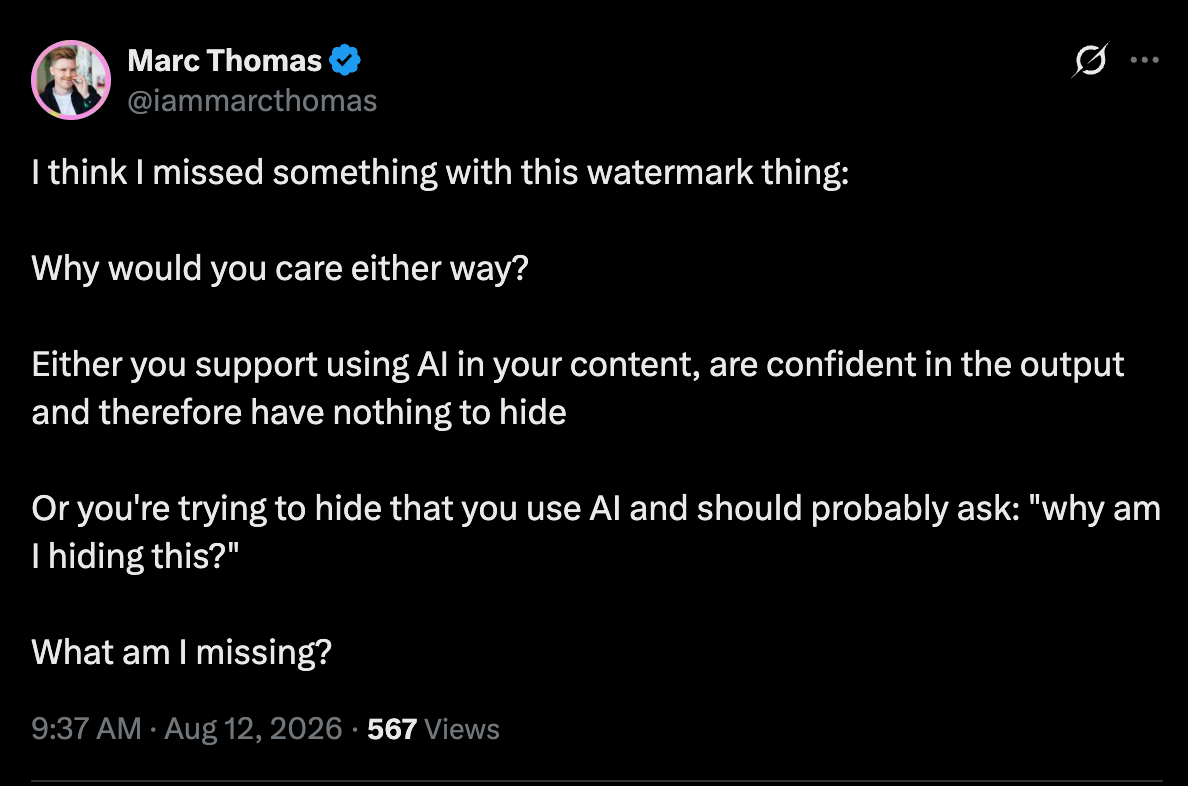
Marc Thomas put it well on X:
I had a few clients ask me about this last week. I generally try to stay ahead of these things and be the first to tell clients: hey this thing happened, here is what it means, here is how it impact us, here is what we're doing about it.
I saw a few other SEOs talking about this conversation with clients as well. Gaetano DiNardi posted this:
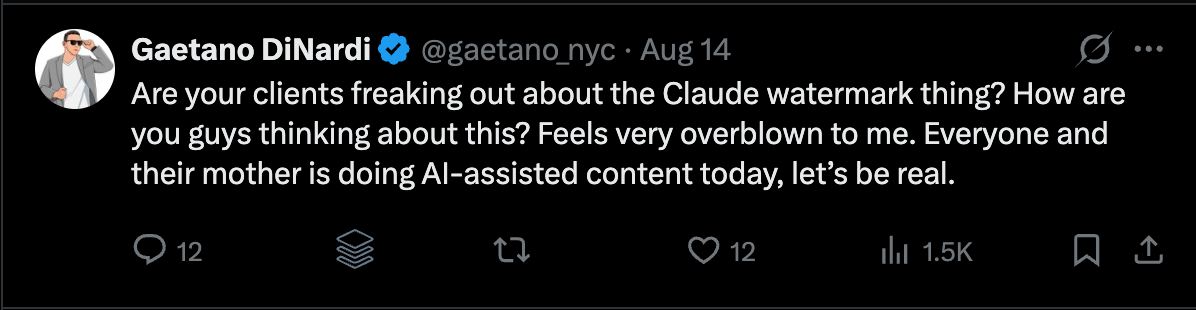
I agree with him - this is totally overblown. So will AI-content detection hurt your SEO? No it won't. Here is why:
Since February 2023, Google's line has been that its focus is on the quality of content rather than how content is produced. The policy it added in March 2024 — scaled content abuse — targets generating many pages for the primary purpose of manipulating rankings rather than helping users. Note what's being penalized there: the no value at scale part, not the AI part. You could violate that policy with a room full of underpaid human writers.
Ahrefs studied AI content in the SERPs earlier this summer and found 5.3% of pages in positions 1–3 were 100% AI-generated, with 9% at 80%+ AI. Across all of page one, pages at 80%+ AI run from 8.4% at position #1 to 11.7% at position #10.
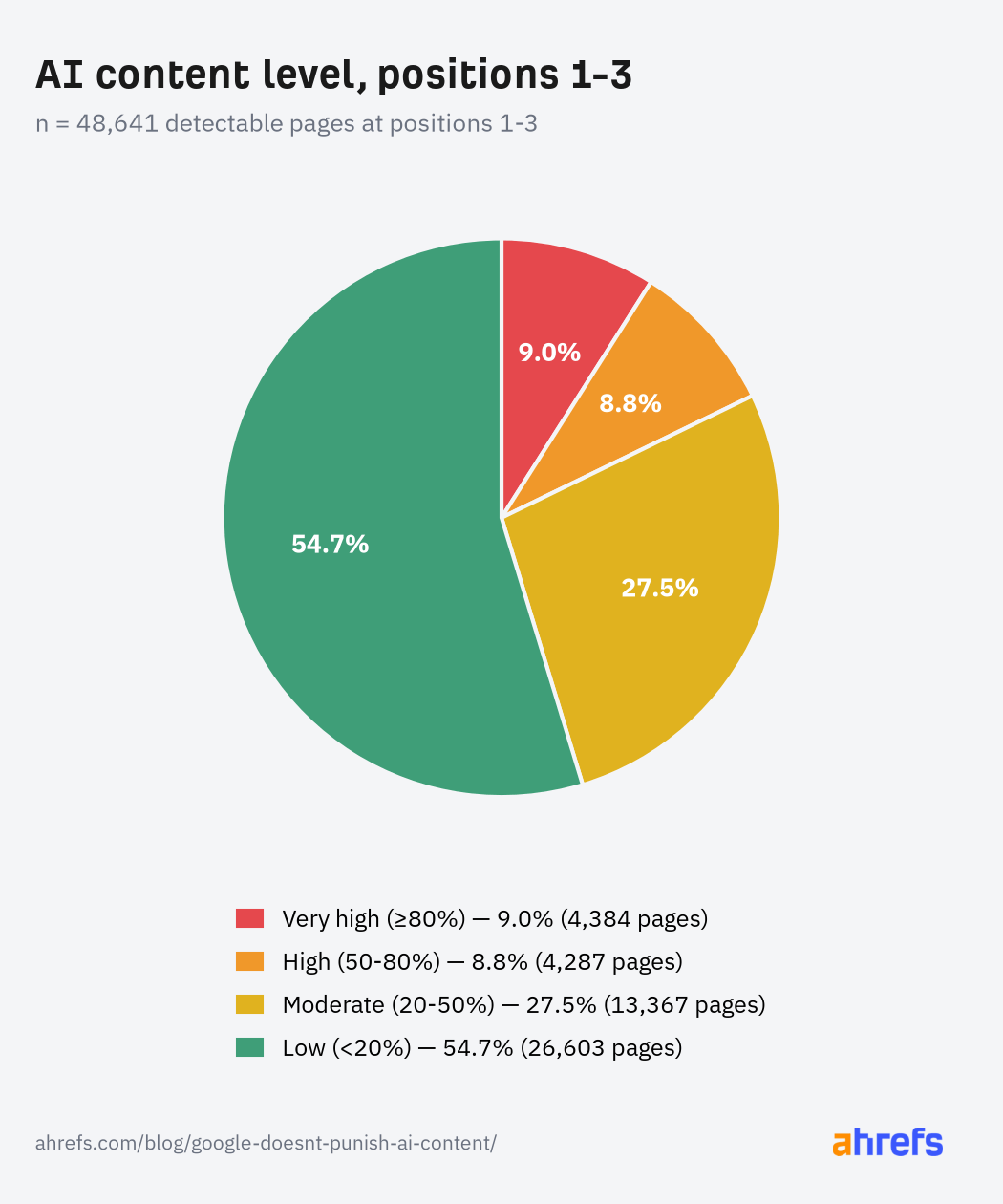
While higher AI use tends to correlate with lower positions, Ahrefs also found an indexation gap — about 49% of low-AI pages indexed versus 40% of very-high-AI pages. But a nine-point spread is not a penalty. It's what you'd expect if AI-heavy pages skew toward lower-effort content generally. What we don't see is a total cliff. AI content sits at every position on page one, including #1. If Google wanted to systematically suppress it, it has had the means and the motive for three years and hasn't done it.
Google signed the same EU transparency code, ships Gemini in its own products, and has poured a staggering amount of money into generative AI. A company that puts AI-generated summaries at the top of its own search results is not about to launch a de-ranking program for AI-assisted blog posts, so long as they don't break the aforementioned guidelines.
Google's problem was never "was an AI model involved?" it was "is this page worth showing someone?" A watermark doesn't answer that question. And let's be serious – Google certainly has the technology and systems to identify AI generated content.
My advice is mostly no. But it's a decent forcing function to check a few things.
As I mentioned, there has a been a ton written and discussed on this topic. Here are some of the best takes I've seen.
Eric Doty wrote about this in a recent Superpath newsletter (if you're not subscribed yet, do yourself a favor and get some Eric in your inbox weekly). Here is his summary of the situation:
"So, in conclusion, I conclude, conclusively, that a whole lot of time and energy will be spent worrying about this, and entire markets might pop up around this, but you, as a content person, can safely ignore all of it."
As always, Kevin Indig went into great depth on this topic, as he always does in his Growth Memo (another must subscribe). Read the whole damn article, but his TL;DR is as follows:
"I'm not worried about watermarking."
Nick Leroy does what does best in his latest #SEOForLunch and rants on this topic (always an insightful and fun read). He shares many of the same thoughts as I do. There are a ton of delicious quotes for me to pull from this lunch patter, but here's one of my favourites:
"Before publishing, ask whether the work is accurate, original enough to justify existing, useful to its intended audience, and something you’re willing to defend with your name attached. If it is, publish it and stand behind it."
Aleyda Solís, who has a justifiably massive SEO following on LinkedIn, polled her audience on this very topic. The responses offer a decent representative sample of how SEOs are feeling about this.
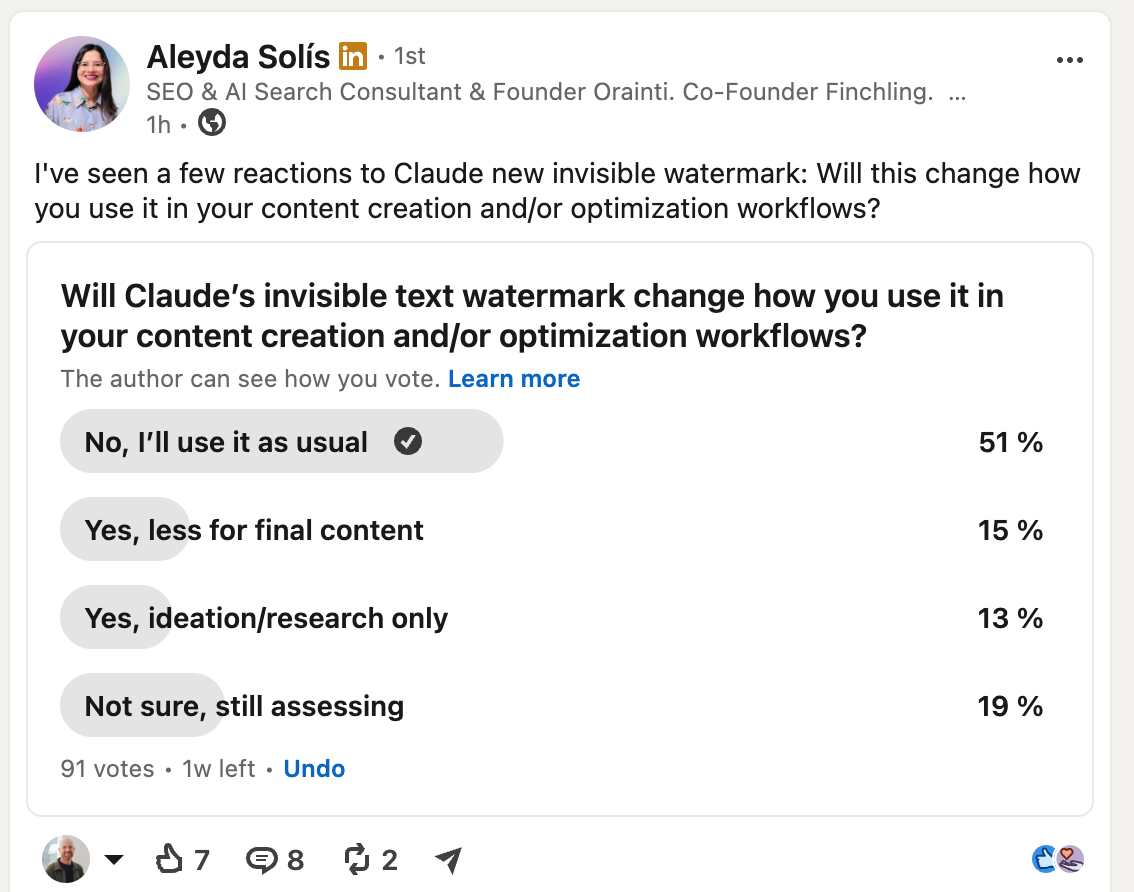
Along with understanding how the best of the best in SEO are thinking and reacting to this news, I wanted to talk to some folks more on the content and editorial side of the house. I reached out to a few of my go-to content folks to get their points of view.
I first had to talk to Jack Virag, the mastermind (CEO and cofounder) of Deadwater, an AI Ops Consultancy, who had some great thoughts (as always).
"Google has a stake in this fight, too. The standalone Gemini app has 1 billion(!) monthly active users as of writing—not including web users and Google Search surfaces. Google wants marketers using AI just as much as Anthropic or OpenAI do.
Plus, the watermark isn't anything new. For the past few years, dozens of companies have been reliably detecting AI-generated content—and even more, like Grammarly, have baked AI detection into their existing tools. This is not a rug-pull moment.
What is important, however, is that your writing—AI or not—is helpful, informative, and authoritative. Given that all of your readers have access to LLMs (and probably prefer it to Google in many cases), our job as marketers is to quit focusing on SEO gamification hacks and start doing what AI cannot: providing real, human perspectives and insights."
Jack is seriously the GOAT of AI content ops. If you need some support here, hit him up.
Samantha Lauron, a freelance content writer who has spent the better part of the last decade in B2B content, shares her thoughts on how things have evolved:
"When AI detection tools first came out years ago, clients would warn me that all of my articles would be reviewed for AI-generated content. I wasn’t worried because I wrote everything myself (and at that point, I hadn’t even explored ChatGPT or Claude yet). But I distinctly remember the first time one of the articles that I spent hours on, and was written fully by me, got flagged as 99% AI written. I went into a full-on panic, explaining to my client that I definitely did not use AI and asking what I needed to do to fix it.
Fast forward to today, and that same client now requests that my drafts be written in Claude so that they’re more AI search-friendly. Just goes to show how quickly content strategies shift!
All that to say, while I appreciate the increased transparency around AI content, I’m not concerned about the watermark. When it comes to writing, foundational storytelling skills will always outlast any tool, strategy, or trend. My priority is to continue creating content that’s helpful, reader-focused, and has an unmistakable brand POV. As long as everything is written with those considerations in mind, then I know the content will be strong whether it’s flagged as AI or not."
Katie Shore, another talented content strategist I collaborate with often, gave me a wonderful response to how she's thinking about this. Her work bridges SEO, content strategy, and writing, so her perspective was uniquely valuable to me.
"First things first: I'm always pro-transparency, so conceptually, I agree with the Claude watermark.
I do really wonder how it'll work in practice, though. A lot of writers rely on it to review briefs or adjust sticky sentences while the work remains, for all intents and purposes, human. Does that mean they'll get flagged for AI content? Will it cause them to leave behind a tool that feels useful for them?
AI writing has also fundamentally changed how we write. I've worked with brands who recommended we don't use em dashes so people don't think we're using AI (even though we were encouraged to). I've also worked with clients who *like* Chat's writing style, and adding those "AI tells" has led to fewer edits total - not because this brand loves AI, but because the style resonates with them and their audience.
It seems inevitable that this watermark will lead to people finding more "AI tells" to avoid. I wonder just how much we can change our writing so it doesn't sound like AI anymore.
I am sensing a shift from relying on AI back to human writers - I think the Claude Watermark could speed that up."
As with many things that promise to kill SEO, this one is very much over-hyped. If you're living in the SEO world these days and doing true, quality work for your clients or employer, this shouldn't scare you. It should actually make you smirk a little bit at all the grifters who are shaking in their boots as they try to stand upright behind their scaled AI slop.
Do I use Claude in my SEO and content workflows with clients? You're damn right I do. Did Claude help me with this article? Yep, it certainly did. As I mentioned earlier, if you're not leveraging AI in your work, no matter what your craft is, you're likely falling way, way behind. Like any tool, it's how you use it – not if you use it.