

Veterinary Emergency Group (VEG) recently rebranded to VEG ER for Pets. Alongside the rebrand, the company undertook a full domain migration, from veterinaryemergencygroup.com to veg.com.

I was brought in to lead SEO strategy and execution for the rebrand and migration, working cross-functionally with brand, design, engineering, content, PR, and senior leadership.
We started planning for the migration in early summer of 2025. The migration launched on October 7, 2025. By January 1, 2026 organic keywords and traffic had fully recovered to pre-migration baselines.
Rebrands are inherently risky from an SEO perspective.
They require asking search engines (and users) o transfer years of brand equity, authority, and trust to a new domain overnight. When combined with a domain migration, the risk multiplies.
In this case, the stakes were high:
We knew going in that:
The real challenge wasn’t avoiding a dip entirely, it was recovering cleanly, predictably, and on schedule, without panic or reactive decision-making.
I led the migration as a fractional SEO leader, responsible for:
This wasn’t about producing a 301 redirect sheet. It was about leading a business-critical transition.
Months before launch, we:
This allowed leadership to understand what would happen, why it would happen, and what success would look like ahead of time.
SEO migrations fail when teams work in silos.
I worked closely with:
Everyone knew their role, timelines were clear, and decisions were documented.
We explicitly set the expectation that:
By defining success as recovery within a known window, we removed emotion from short-term volatility.
This meant no panic in week one—even when traffic dipped exactly as expected.
Post-launch, I shifted into active monitoring and leadership communication mode:
No one had to ask how the migration was going—they already knew.
I used SEO Gets to combine Google Search Console data across both domains, allowing us to:
Each report included:
This kept all stakeholders aligned and confident throughout the recovery period.
By the first week of January, organic performance had returned to baseline—right on schedule.
Just as importantly:
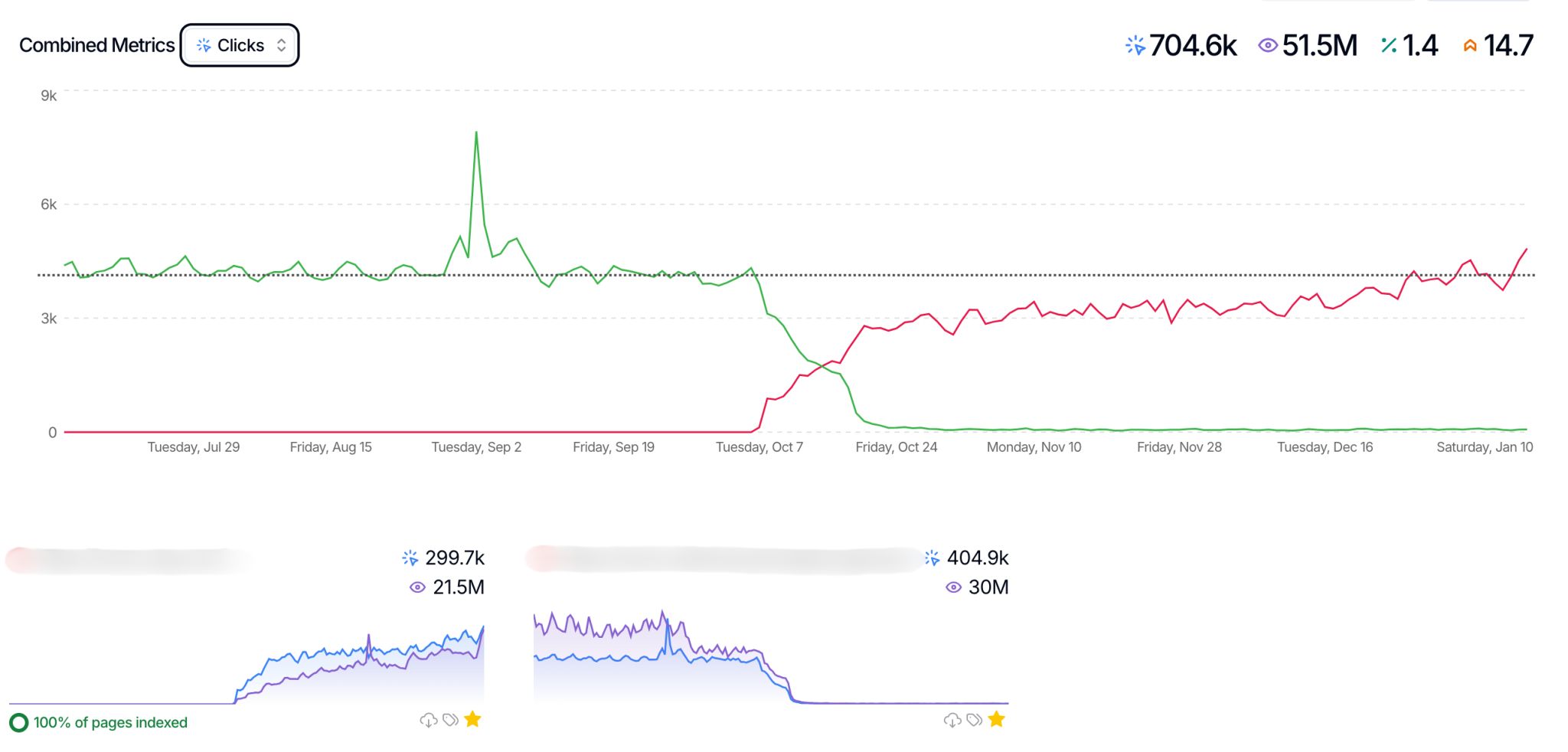
This migration succeeded because it was treated as a leadership problem, not just a technical checklist.
Key factors:
Migrations aren’t won on launch day. They’re won in the months before and the weeks after.
This wasn’t a “me” win. It was a team win.
Having clients who collaborate, trust the process, and value clear communication makes all the difference, especially during high-risk transitions like rebrands and domain migrations.
If you’re planning a rebrand, domain migration, or both at the same time, I help teams navigate these moments with clarity, confidence, and predictability—so SEO supports the business instead of becoming a source of stress.


Jason Faber is a Fractional SEO Consultant and Growth Advisor with 20 years of experience. Based in Toronto, operating worldwide.



.png)
